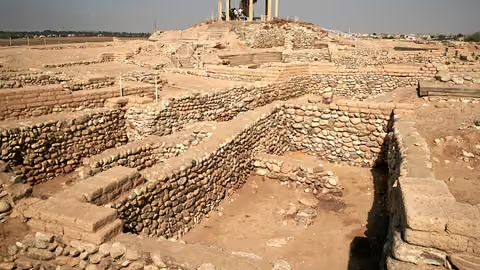
Beersheba
The well of the oath, where the map of the promise ends and begins.
Read aloud: Genesis 21:22-34, 1 Kings 19:1-8.
Genesis 21:22-34
At that time, Abimelech and Phicol the captain of his army spoke to Abraham, saying, “God is with you in all that you do. Now, therefore, swear to me here by God that you will not deal falsely with me, nor with my son, nor with my son’s son. But according to the kindness that I have done to you, you shall do to me, and to the land in which you have lived as a foreigner.” Abraham said, “I will swear.” Abraham complained to Abimelech because of a water well, which Abimelech’s servants had violently taken away. Abimelech said, “I don’t know who has done this thing. You didn’t tell me, and I didn’t hear of it until today.” Abraham took sheep and cattle, and gave them to Abimelech. Those two made a covenant. Abraham set seven ewe lambs of the flock by themselves. Abimelech said to Abraham, “What do these seven ewe lambs which you have set by themselves mean?” He said, “You shall take these seven ewe lambs from my hand, that it may be a witness to me, that I have dug this well.” Therefore he called that place Beersheba, because they both swore an oath there. So they made a covenant at Beersheba. Abimelech rose up with Phicol, the captain of his army, and they returned into the land of the Philistines. Abraham planted a tamarisk tree in Beersheba, and called there on the name of Yahweh, the Everlasting God. Abraham lived as a foreigner in the land of the Philistines many days.
Why here
From Dan to Beersheba: we began this library at the northern gate, and here is the southern one, the last wells before the great desert, the edge where the sown land gives way to the wilderness.
Abraham secured water rights here with seven lambs and an oath, Isaac re-dug the wells, Jacob left from here for Egypt, and the phrase from Dan to Beersheba became scripture's own way of saying: all of it, the whole land.
Your feet have now touched both ends of the sentence.
Living people
Abraham, the well-digger.
He fought no battle here.
He dug, he negotiated, he swore, he planted a tree he would never sit under full grown, and he called on the name of El Olam, the Everlasting God.
Wells, oaths and slow trees: the unglamorous infrastructure of a promise.
Isaac, the re-digger.
His whole recorded career at these wells was opening again what his father dug and enemies stopped.
Some generations are called to discover.
Some are called to unstop.
Both are covenant work.
One thing the eye can verify
At Tel Beersheba stands a great reconstructed horned altar, found dismantled in the ruins, its stones reused in a wall, most likely taken apart in King Hezekiah's reforms: archaeology catching the Bible's kings in the act of obeying.
And at the old city, a well by the gate is still shown as Abraham's.
Dig sites come and go, but for four thousand years nobody has settled the Negev without doing exactly what Abraham did first: find water, keep oaths, plant trees.
One Hebrew word
שְׁבוּעָה Shevua, oath, twin of sheva, seven. Be'er Sheva: the well of the oath and of the seven lambs at once. Hebrew sews the two together because a real oath, like the number seven, means complete: nothing held back.
One question
Abraham planted a tamarisk, the slowest of desert trees, in the land of his sojourning. What are you planting that only your grandchildren will sit under?
A prayer
Lord, Everlasting God, El Olam, You were called by that name first at this well. Be everlasting over our families. Guard our wells, keep our oaths, and give us the faith of the tamarisk planters, who watered what they would never see. From Dan to Beersheba, the land is Yours, and so are we. Amen.
Nearby
- Arad The desert fortress with a temple in it, and the Name on broken pottery.
- Lachish The fortress of Judah, and the arm that is not flesh.
- Gath The Philistine mound that sent a giant into the valley.
In The South. Next: Gath.
Same book: Hebron (Genesis), Mount Sodom (Genesis).
Walk this place with me. A private day.