Arad
The desert fortress with a temple in it, and the Name on broken pottery.
Read aloud: Numbers 21:1-3.
Numbers 21:1-3
The Canaanite, the king of Arad, who lived in the South, heard that Israel came by the way of Atharim. He fought against Israel, and took some of them captive. Israel vowed a vow to Yahweh, and said, “If you will indeed deliver this people into my hand, then I will utterly destroy their cities.” Yahweh listened to the voice of Israel, and delivered up the Canaanites; and they utterly destroyed them and their cities. The name of the place was called Hormah.
Why here
Arad guarded the eastern Negev, where the road from the wilderness climbed toward the hill country, which is why the king of Arad struck at Israel in the wilderness years: he was defending the on-ramp to the land.
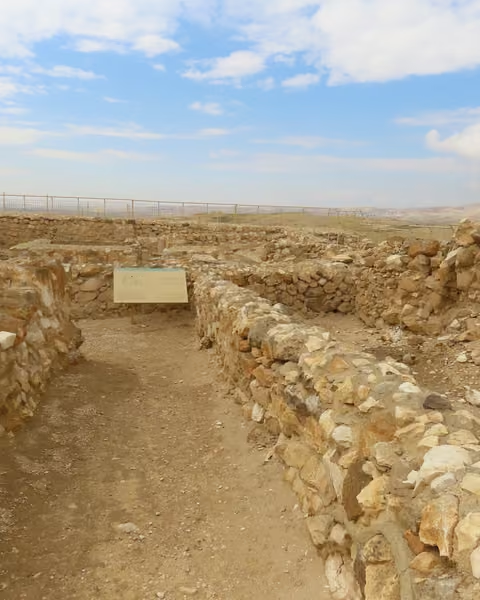
The Canaanite city fell, and centuries later an Israelite fortress rose on the ridge above it, garrisoned by Judah's soldiers at the kingdom's desert edge.
What the spade found inside that fortress made this quiet tel one of the most important sites in biblical archaeology.
Living people
The garrison scribes.
The soldiers of Arad wrote supply orders on pottery shards, and dozens survived: bread, wine, oil, troop movements, and on one ostracon, a line that stops the breath, a blessing by the house of Yahweh.
Ordinary quartermasters, blessing in the Name between ration lists.
Faith in this land has always lived in the paperwork too.
Israel, vowing.
The nation's first victory in the conquest generation came here, at the door of the south, from a vow kept on both sides.
One thing the eye can verify
Inside the fortress the excavators found the only full Israelite temple ever unearthed: courtyard, holy place, and a holy of holies with standing stones and two incense altars, a little Judahite sanctuary at the desert edge, apparently decommissioned, packed away with care, in the reforms of Judah's kings.
The altars stand today in the Israel Museum.
Your group can look at the actual furniture of the debate the books of Kings record.
One Hebrew word
קְטֹרֶת Ketoret, incense. The two small altars of Arad still bear traces of what was burned to heaven from the desert's edge. The psalmist gave the translation: let my prayer be set before You as ketoret. Prayer, in this land, has always risen from the frontier posts too.
One question
The soldiers of Arad blessed in God's Name inside their supply lists. Does the Name appear anywhere in your ordinary paperwork, or only in your Sabbath?
A prayer
Lord, You met Israel at the door of the south and You met the garrison in its ration notes. Meet us in ours. Let our invoices and our messages carry Your blessing like the ostraca of Arad, and let our prayers rise like ketoret from whatever frontier You have posted us to. Amen.
Nearby
- Beersheba The well of the oath, where the map of the promise ends and begins.
- Lachish The fortress of Judah, and the arm that is not flesh.
- Valley of Elah The brook where a shepherd chose five stones.
- Gath The Philistine mound that sent a giant into the valley.
In The South. Before: Lachish. Next: Timna.
Walk this place with me. A private day.