Library · Approaches & Mount of Olives
Bethany
The village of Mary, Martha, and Lazarus.
Read aloud: John 11:17-44, John 11:17-27.
John 11:17-44
So when Jesus came, he found that he had been in the tomb four days already. Now Bethany was near Jerusalem, about fifteen stadia away. Many of the Jews had joined the women around Martha and Mary, to console them concerning their brother. Then when Martha heard that Jesus was coming, she went and met him, but Mary stayed in the house. Therefore Martha said to Jesus, “Lord, if you would have been here, my brother wouldn’t have died. Even now I know that, whatever you ask of God, God will give you.” Jesus said to her, “Your brother will rise again.” Martha said to him, “I know that he will rise again in the resurrection at the last day.” Jesus said to her, “I am the resurrection and the life. He who believes in me will still live, even if he dies. Whoever lives and believes in me will never die. Do you believe this?” She said to him, “Yes, Lord. I have come to believe that you are the Christ, God’s Son, he who comes into the world.” When she had said this, she went away, and called Mary, her sister, secretly, saying, “The Teacher is here, and is calling you.” When she heard this, she arose quickly, and went to him. Now Jesus had not yet come into the village, but was in the place where Martha met him. Then the Jews who were with her in the house, and were consoling her, when they saw Mary, that she rose up quickly and went out, followed her, saying, “She is going to the tomb to weep there.” Therefore when Mary came to where Jesus was, and saw him, she fell down at his feet, saying to him, “Lord, if you would have been here, my brother wouldn’t have died.” When Jesus therefore saw her weeping, and the Jews weeping who came with her, he groaned in the spirit, and was troubled, and said, “Where have you laid him?” They told him, “Lord, come and see.” Jesus wept. The Jews therefore said, “See how much affection he had for him!” Some of them said, “Couldn’t this man, who opened the eyes of him who was blind, have also kept this man from dying?” Jesus therefore, again groaning in himself, came to the tomb. Now it was a cave, and a stone lay against it. Jesus said, “Take away the stone.” Martha, the sister of him who was dead, said to him, “Lord, by this time there is a stench, for he has been dead four days.” Jesus said to her, “Didn’t I tell you that if you believed, you would see God’s glory?” So they took away the stone from the place where the dead man was lying. Jesus lifted up his eyes, and said, “Father, I thank you that you listened to me. I know that you always listen to me, but because of the multitude standing around I said this, that they may believe that you sent me.” When he had said this, he cried with a loud voice, “Lazarus, come out!” He who was dead came out, bound hand and foot with wrappings, and his face was wrapped around with a cloth. Jesus said to them, “Free him, and let him go.”
Why here
Two small villages on the eastern slope of the Mount of Olives, just over the ridge from Jerusalem, on the last stretch of the pilgrim road from Jericho.
Bethphage is where the donkey was untied for the descent of Palm Sunday.
Bethany was His Judean home: the house of Martha, Mary and Lazarus, the friends who fed Him and the table He returned to.
Its name means house of the afflicted, and it earned the name honestly, and then one afternoon at its cemetery the affliction was ordered out loud to give back what it took.
Living people
Martha.
The practical one, arguing logistics at a tomb: Lord, there is a stench.
Faith and realism wrestling in a single sentence, and Jesus does not scold her.
He raises the stakes: you will see God's glory.
Lazarus.
The friend.
The text never records a single word he spoke, before or after.
He is famous forever for one thing only: he came out when he was called.
Jesus, groaning.
Twice the text says it.
He wept at this village and groaned at this tomb.
He does not perform the miracle coolly.
He does it moved.
One thing the eye can verify
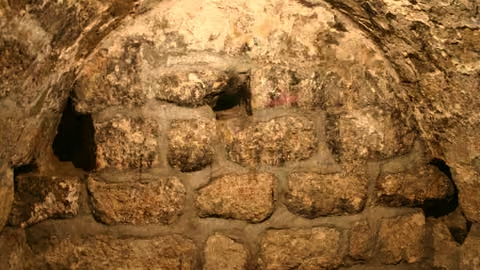
The tomb of Lazarus is still there in Bethany, cut in the rock, down worn steps into a cold chamber.
Climb down into it, then climb back out into the sunlight, and feel what the story means with your legs.
Every guest who walks up those steps is rehearsing the ending of the Book.
Come out is the last command death ever hears.
One Hebrew word
בֵּית עַנְיָה Beit Anya, house of the afflicted, house of the poor. He made His home in the town named for affliction. He still does. If your house has ever carried that name, know who chooses such addresses on purpose.
One question
Lazarus came out alive but still bound, and Jesus turned to the community: free him, and let him go. Who around you is already alive in Christ but still wrapped, waiting for hands to unbind them?
A prayer
Lord, You groaned at our graves and wept at our gates, and then You called the dead man by name. Call ours. Roll the stones we have given up on. And when the ones You raise come out still bound, make us the hands that unwrap them. Free them, and let them go. Amen.
Nearby
- Bethphage The village of the colt, at the top of the descent.
- Mount of Olives The ridge where the King descended, and wept.
- Pater Noster The ridge where He taught them to pray.
In Approaches & Mount of Olives. Before: Pater Noster. Next: Bethphage.
Same book: Pool of Siloam (John), Church of the Holy Sepulchre (John).
More pages: Library.