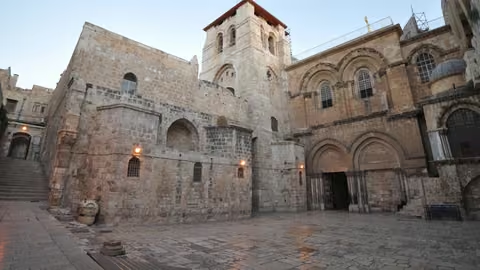
Church of the Holy Sepulchre
With the rich in his death · Isaiah 53:9.
Read aloud: John 19:16-42, John 20:1-18, Isaiah 53:9.
John 19:16-42
So then he delivered him to them to be crucified. So they took Jesus and led him away. He went out, bearing his cross, to the place called “The Place of a Skull”, which is called in Hebrew, “Golgotha”, where they crucified him, and with him two others, on either side one, and Jesus in the middle. Pilate wrote a title also, and put it on the cross. There was written, “JESUS OF NAZARETH, THE KING OF THE JEWS.” Therefore many of the Jews read this title, for the place where Jesus was crucified was near the city; and it was written in Hebrew, in Latin, and in Greek. The chief priests of the Jews therefore said to Pilate, “Don’t write, ‘The King of the Jews,’ but, ‘he said, “I am King of the Jews.”’” Pilate answered, “What I have written, I have written.” Then the soldiers, when they had crucified Jesus, took his garments and made four parts, to every soldier a part; and also the tunic. Now the tunic was without seam, woven from the top throughout. Then they said to one another, “Let’s not tear it, but cast lots for it to decide whose it will be,” that the Scripture might be fulfilled, which says, “They parted my garments among them. They cast lots for my clothing.” Therefore the soldiers did these things. But standing by Jesus’ cross were his mother, his mother’s sister, Mary the wife of Clopas, and Mary Magdalene. Therefore when Jesus saw his mother, and the disciple whom he loved standing there, he said to his mother, “Woman, behold, your son!” Then he said to the disciple, “Behold, your mother!” From that hour, the disciple took her to his own home. After this, Jesus, seeing that all things were now finished, that the Scripture might be fulfilled, said, “I am thirsty!” Now a vessel full of vinegar was set there; so they put a sponge full of the vinegar on hyssop, and held it at his mouth. When Jesus therefore had received the vinegar, he said, “It is finished!” Then he bowed his head and gave up his spirit. Therefore the Jews, because it was the Preparation Day, so that the bodies wouldn’t remain on the cross on the Sabbath (for that Sabbath was a special one), asked of Pilate that their legs might be broken and that they might be taken away. Therefore the soldiers came and broke the legs of the first and of the other who was crucified with him; but when they came to Jesus and saw that he was already dead, they didn’t break his legs. However, one of the soldiers pierced his side with a spear, and immediately blood and water came out. He who has seen has testified, and his testimony is true. He knows that he tells the truth, that you may believe. For these things happened that the Scripture might be fulfilled, “A bone of him will not be broken.” Again another Scripture says, “They will look on him whom they pierced.” After these things, Joseph of Arimathaea, being a disciple of Jesus, but secretly for fear of the Jews, asked of Pilate that he might take away Jesus’ body. Pilate gave him permission. He came therefore and took away his body. Nicodemus, who at first came to Jesus by night, also came bringing a mixture of myrrh and aloes, about a hundred Roman pounds. So they took Jesus’ body, and bound it in linen cloths with the spices, as the custom of the Jews is to bury. Now in the place where he was crucified there was a garden. In the garden was a new tomb in which no man had ever yet been laid. Then, because of the Jews’ Preparation Day (for the tomb was near at hand), they laid Jesus there.
Why here
John gives the geography in one phrase: near the city.
John notes the geography with a gardener's precision: in the place where He was crucified there was a garden, and in the garden a new tomb.
Friends, I bring you inside these walls because the Book says the skull-place was near the city, and that in the place where He was crucified there was a garden, and in the garden a new tomb. Whether you pray at the Church of the Holy Sepulchre or at a garden tomb north of the wall, the geography the Gospel wants is this: death and a garden, close enough to walk.
Why here of all places? Rome executed beside a road, to advertise. God planted a garden beside an execution. The two addresses touch. You cannot tell Easter without Friday, and you cannot tell Friday without the garden that received the body before dawn on the first day.
Living people
Joseph of Arimathea and Nicodemus, secret disciples who become public at the worst time. They ask for the body. Love does the burial when hope looks finished.
Mary Magdalene, at the tomb while it was still dark. She came to a corpse and met the Teacher. The first preacher of the resurrection is a woman who stayed.
Jesus, crucified under a title in Hebrew, Latin, and Greek. The nations were already in the inscription.
One thing the eye can verify
Stone. Close air. The smell of incense or of garden, depending where you stand. Your eye can verify the nearness: tomb and city wall are not a day's journey apart. The Gospel's claim is local. He died here. He was laid here. The place was empty here.
One Hebrew word
קוּם qum, rise, stand up. The verb of resurrection and of getting a child out of bed. He is not a memory in a shrine. The word that unlocks this church is the command death could not keep Him from obeying.
One question
Have you come here to perfume a death, or to hear your name spoken by the living One?
A prayer
Lord Jesus, You died outside the gate and rose in a garden. Meet us in the dark. Call us by name. And send us to tell the brothers, He is risen. Amen.
Nearby
- Golgotha The place of the skull, where it was finished.
- The Old City One square kilometer, four quarters, every century still open.
- Via Dolorosa The way of sorrow, walked in the green tree.
In Within the walls. Before: Pool of Bethesda. Next: Golgotha.
Same book: The empty tomb (John), Pool of Siloam (John).
Walk this place with me. A private day.