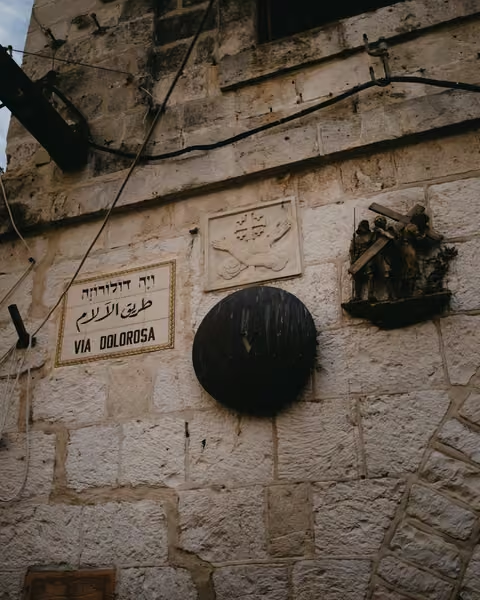
Via Dolorosa
The way of sorrow, walked in the green tree.
Read aloud: Luke 23:26-31, Isaiah 53:7, Zechariah 12:10.
Luke 23:26-31
When they led him away, they grabbed one Simon of Cyrene, coming from the country, and laid the cross on him to carry it after Jesus. A great multitude of the people followed him, including women who also mourned and lamented him. But Jesus, turning to them, said, “Daughters of Jerusalem, don’t weep for me, but weep for yourselves and for your children. For behold, the days are coming in which they will say, ‘Blessed are the barren, the wombs that never bore, and the breasts that never nursed.’ Then they will begin to tell the mountains, ‘Fall on us!’ and tell the hills, ‘Cover us.’ For if they do these things in the green tree, what will be done in the dry?”
Why here
The Way of Sorrow threads today through the market streets of the Old City, from the area of the Antonia fortress toward Golgotha, fourteen stations deep in incense and noise.
The exact Roman pavement lies meters below the present street, but the direction is true and the distance is short: the most consequential walk in history was a few hundred meters through a crowded city on a festival morning, past shoppers and soldiers and people who never looked up.
The world's redemption elbowed its way through a market.
Living people
Simon of Cyrene.
A pilgrim from North Africa, in from the country, grabbed out of the crowd and handed the beam.
He came to Jerusalem for Passover and left carrying the cross of the Lamb.
Mark names his sons, Alexander and Rufus, as men the early church knew, which tells you what that forced walk did to his family.
The daughters of Jerusalem.
Even under the beam, His concern ran toward them: do not weep for me.
He was comforting mourners on the way to His own execution.
That is who walked this street.
One thing the eye can verify
Walk it early, before the shops open, when the street is quiet enough to hear your own steps on the stone.
Or walk it at full market roar, which is more honest: it looked like this, crowded and loud and mostly indifferent.
Either way, watch your group's pace change.
Nobody strolls the Via Dolorosa.
The body understands this street before the mind does.
One Hebrew word
דֶּרֶךְ הַיִּסּוּרִים Derech HaYisurim, the way of the sufferings. Hebrew keeps the plural: not one sorrow but the gathered sorrows, His and ours, carried down one narrow street. Isaiah wrote the caption seven centuries early: surely he has borne our griefs and carried our sorrows.
One question
Simon was grabbed from the crowd and made to carry it. Grace often starts as an interruption we did not volunteer for. What interruption in your life might actually be the cross you were chosen to carry behind Him?
A prayer
Lord, You walked the way of sorrows through an ordinary market morning, and You comforted the weeping while You bled. Give us Simon's shoulders when we are grabbed from the crowd. And as we walk Your street, let our hearts refuse to be one more face that never looked up. Amen.
Nearby
- The Old City One square kilometer, four quarters, every century still open.
- Temple Mount The mountain where it is provided.
- Church of the Holy Sepulchre With the rich in his death · Isaiah 53:9.
In Within the walls. Before: The empty tomb. Next: Upper Room.
Same book: Gethsemane (Luke), Dominus Flevit (Luke).
Walk this place with me. A private day.