Library · Approaches & Mount of Olives
Mount of Olives
The ridge where the King descended, and wept.
Read aloud: Luke 19:37-44, Zechariah 14:3-9, Acts 1:9-12.
Luke 19:37-44
As he was now getting near, at the descent of the Mount of Olives, the whole multitude of the disciples began to rejoice and praise God with a loud voice for all the mighty works which they had seen, saying, “Blessed is the King who comes in the name of the Lord! Peace in heaven, and glory in the highest!” Some of the Pharisees from the multitude said to him, “Teacher, rebuke your disciples!” He answered them, “I tell you that if these were silent, the stones would cry out.” When he came near, he saw the city and wept over it, saying, “If you, even you, had known today the things which belong to your peace! But now, they are hidden from your eyes. For the days will come on you when your enemies will throw up a barricade against you, surround you, hem you in on every side, and will dash you and your children within you to the ground. They will not leave in you one stone on another, because you didn’t know the time of your visitation.”
Why here
The Mount of Olives is the eastern wall of Jerusalem's world: a ridge higher than the Temple Mount, facing it across the narrow Kidron valley.
Whoever descends its slope sees the whole city rise up to meet them, which is why the Palm Sunday road runs down this hill and why the crowds' shout and His weeping happened within the same few hundred meters.
From this ridge He taught, here He wept, from here He ascended, and to this ridge Zechariah says the King returns: on that day his feet will stand on the Mount of Olives.
Luke 19:37-42 · also: Zechariah 14:4 · Acts 1:9-12
Living people
Jesus, riding down.
The only day He accepted the crowd's worship, and in the middle of the singing He looked at the city and broke down crying, a King in tears over the city that would not know its hour.
Rejoicing and weeping on the same donkey, on the same slope.
The crowd and the stones.
Rebuke them, said the officials.
He answered that silence was not an option that exists: if these were silent, the stones would cry out.
On this mountain of ancient stones, that was not a metaphor chosen at random.
One thing the eye can verify
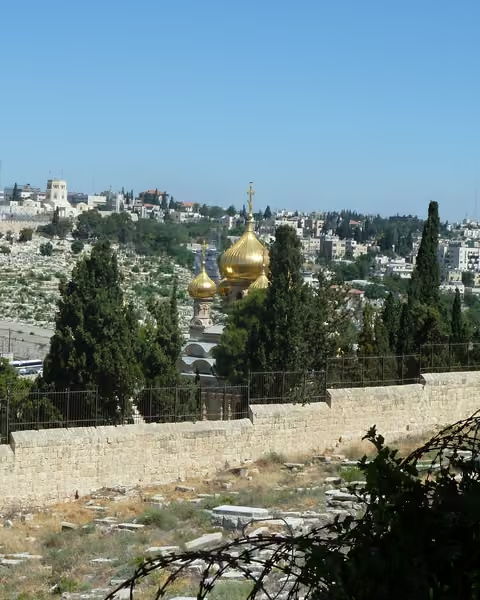
Stand at the lookout and take in the view every pilgrim photographs: the golden city, the sealed Eastern Gate directly opposite, and below you, flowing down the slope, the oldest active cemetery on earth, generations of Jews buried facing the gates, waiting for resurrection morning exactly where Zechariah planted the promise.
This whole mountainside is a congregation lying down, facing forward.
One Hebrew word
זַיִת Zayit, olive. The tree of this ridge and of this land. The olive gives its light only when crushed, and the oil of these slopes lit the menorah of the Temple across the valley. Remember that word when we walk down to the olive press at the bottom of this hill.
One question
He wept over a city for missing the things that belong to its peace. If He looked at your life today, what hidden thing that belongs to your peace would He weep over?
A prayer
Lord, Blessed is the King who comes in the name of the Lord. We will not be silent, lest the stones outsing us. Show us today the things that belong to our peace, while it is still today. And come back to this ridge soon, as You promised. Amen.
Nearby
- Pater Noster The ridge where He taught them to pray.
- Dominus Flevit The place He wept over the city.
- Bethphage The village of the colt, at the top of the descent.
In Approaches & Mount of Olives. Next: Gethsemane.
Same book: Via Dolorosa (Luke), Upper Room (Luke).
Walk this place with me. A private day.