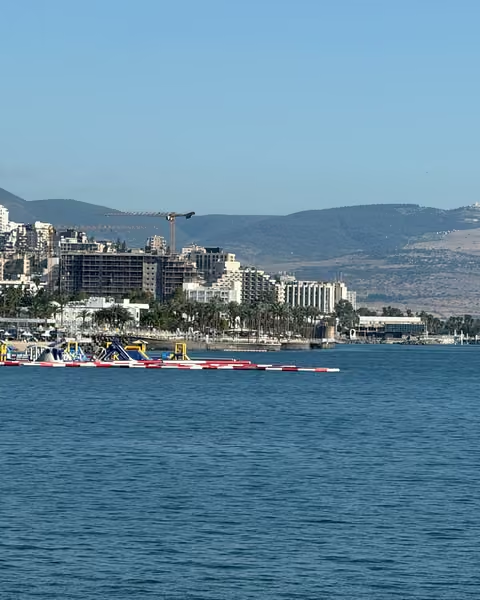
Tiberias
The emperor's city that ended up guarding the Word.
Read aloud: John 6:16-27, John 21:15-19.
John 6:16-27
When evening came, his disciples went down to the sea, and they entered into the boat, and were going over the sea to Capernaum. It was now dark, and Jesus had not come to them. The sea was tossed by a great wind blowing. When therefore they had rowed about twenty-five or thirty stadia, they saw Jesus walking on the sea, and drawing near to the boat; and they were afraid. But he said to them, “It is I. Don’t be afraid.” They were willing therefore to receive him into the boat. Immediately the boat was at the land where they were going. On the next day, the multitude that stood on the other side of the sea saw that there was no other boat there, except the one in which his disciples had embarked, and that Jesus hadn’t entered with his disciples into the boat, but his disciples had gone away alone. However boats from Tiberias came near to the place where they ate the bread after the Lord had given thanks. When the multitude therefore saw that Jesus wasn’t there, nor his disciples, they themselves got into the boats, and came to Capernaum, seeking Jesus. When they found him on the other side of the sea, they asked him, “Rabbi, when did you come here?” Jesus answered them, “Most certainly I tell you, you seek me, not because you saw signs, but because you ate of the loaves, and were filled. Don’t work for the food which perishes, but for the food which remains to eternal life, which the Son of Man will give to you. For God the Father has sealed him.”
Why here
Herod Antipas built this city new and named it for his patron, the emperor Tiberius: a Roman resort with a Roman name, planted partly over old graves, so that many observant Jews at first refused to set foot in it.
The Gospels never record Jesus entering it, only boats from Tiberias circling the lake looking for Him.
And then history turned the tables.
After Jerusalem fell, the sages moved north, and this pagan-named city became one of the four holy cities of Judaism, where the Mishnah was sealed nearby, and where the Masoretes of Tiberias spent centuries fixing every letter and vowel of the Hebrew Bible.
Living people
Herod Antipas.
The fox.
Builder of this city, killer of John the Baptist, the ruler who wanted to see a miracle and got silence at the trial.
He named his capital for Rome and lost everything, exiled by Rome itself.
The crowd in the boats.
They chased Jesus around a lake for breakfast, and He loved them enough to say it to their faces: you seek the loaves, not the sign.
Then He offered them the food that does not perish.
One thing the eye can verify
Open any Hebrew Bible, anywhere on earth, and look at the little dots and lines under the letters, the vowel points.
That system was perfected here, by the Masoretes of Tiberias, families who counted every letter of scripture for generations so nothing would be lost.
The emperor's resort became the safe-deposit box of the Word.
Every Bible your group is holding has Tiberias hidden inside it.
One Hebrew word
מָסוֹרָה Masorah, that which is handed down, from masar, to hand over. The craft of passing the Word along unbroken, letter by letter, generation by generation. Tiberias is the city of the handing down.
One question
Jesus separated the loaf-seekers from the sign-seekers with one sentence. Which are you chasing Him for today, and would you still row across the lake if the bread ran out?
A prayer
Lord, feed us with the food that remains. We thank You for every hidden guardian who handed Your Word down to us unbroken, letter by letter, from this shore. Make us faithful hands in that chain. And keep us seeking You, not only Your bread. Amen.
Nearby
- Magdala A synagogue of his years.
- Sea of Galilee Even the wind and the sea · Mark 4:35-41.
- Tabgha The seven springs, where little became enough.
In Galilee. Before: Bethsaida. Next: Yardenit.
Same book: Cana (John), Shechem (John).
Walk this place with me. A private day.