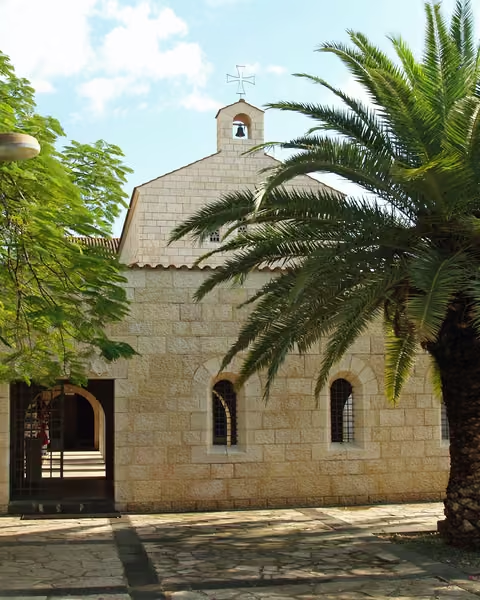
Tabgha
The seven springs, where little became enough.
Read aloud: Ezekiel 34:11-16.
Ezekiel 34:11-16
“‘For the Lord GOD says: “Behold, I myself, even I, will search for my sheep, and will seek them out. As a shepherd seeks out his flock in the day that he is among his sheep that are scattered abroad, so I will seek out my sheep. I will deliver them out of all places where they have been scattered in the cloudy and dark day. I will bring them out from the peoples, and gather them from the countries, and will bring them into their own land. I will feed them on the mountains of Israel, by the watercourses, and in all the inhabited places of the country. I will feed them with good pasture, and their fold will be on the mountains of the height of Israel. There they will lie down in a good fold. They will feed on rich pasture on the mountains of Israel. I myself will be the shepherd of my sheep, and I will cause them to lie down,” says the Lord GOD. “I will seek that which was lost, and will bring back that which was driven away, and will bind up that which was broken, and will strengthen that which was sick; but I will destroy the fat and the strong. I will feed them in justice.”’
Why here
Tabgha is Greek Heptapegon worn down by centuries of tongues: the Seven Springs.
Warm mineral water rises here and slides into the lake, and the warmth draws the fish, which is why the fishermen of Capernaum worked these shores and why hungry crowds could find Jesus here, on the grassy edge between the springs and the water.
A crossroads of paths along the northwest shore, close enough for a boy to arrive carrying his lunch.
The mathematics of heaven happened at a fishing spot.
Living people
Philip.
The local boy from Bethsaida, tested with a question about bread.
He answers with arithmetic: two hundred denarii would not be enough.
Philip calculates.
Jesus multiplies.
Andrew.
The bringer.
He finds a boy with five loaves and brings him forward while admitting it makes no sense.
The boy.
Unnamed forever, the child whose lunch fed five thousand because he handed it over whole.
One thing the eye can verify
In the Church of the Multiplication, look at the famous mosaic by the altar: the basket holds only FOUR loaves.
The fifth is not missing.
The fifth is on the altar, the Byzantine artists' way of saying the miracle is still being distributed.
Fifteen centuries later the sermon in the floor still preaches.
One Hebrew word
לֶחֶם Lechem, bread. The most ordinary word in the language, and the one He chose to multiply. He does not usually make something from nothing. He makes enough from what is handed to Him.
One question
Philip calculated and Andrew brought what there was. Which one are you today, and what five loaves are still in your hands?
A prayer
Lord, You asked for the little that was there, and it fed everyone. Here is our little. Our five loaves, our two fish, our small strength. Take it, give thanks over it, and make it enough. And let nothing be lost. Amen.
Nearby
- Mount of Beatitudes The hillside above the Sea of Galilee.
- Capernaum Kfar Nachum, His own city, on the Via Maris.
- Chorazin The city of the unrecorded miracles.
In Galilee. Before: Capernaum. Next: Mount of Beatitudes.
Same book: Eastern Gate (Ezekiel), Masada (Ezekiel).
More pages: Library.