Chorazin
The city of the unrecorded miracles.
Read aloud: Matthew 11:20-24, Luke 10:13-15.
Matthew 11:20-24
Then he began to denounce the cities in which most of his mighty works had been done, because they didn't repent. "Woe to you, Chorazin! Woe to you, Bethsaida! For if the mighty works had been done in Tyre and Sidon which were done in you, they would have repented long ago in sackcloth and ashes. But I tell you, it will be more tolerable for Tyre and Sidon on the day of judgment than for you. You, Capernaum, who are exalted to heaven, you will go down to Hades. For if the mighty works had been done in Sodom which were done in you, it would have remained until today. But I tell you that it will be more tolerable for the land of Sodom, on the day of judgment, than for you."
Why here
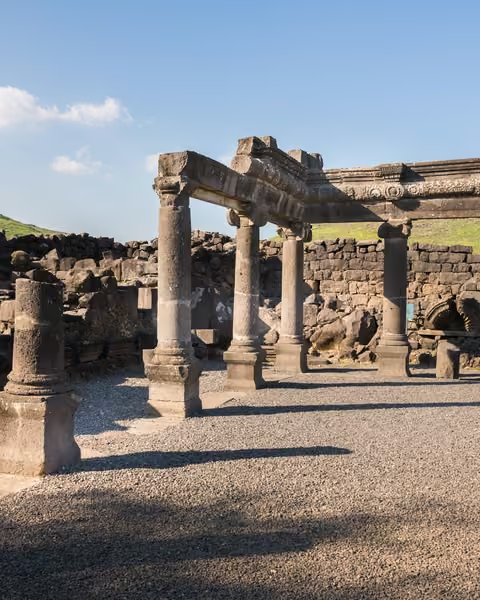
Chorazin sits on the basalt heights just above Capernaum, the third corner of what pilgrims call the evangelical triangle: Chorazin, Bethsaida, Capernaum, the little triangle of towns where the text says MOST of His mighty works were done.
Stop and hear that.
The Gospels record about three dozen miracles.
This verse says most of them happened here, in these three towns, and were never written down.
We are standing in a city full of miracles that have no chapter and no verse.
Only the woe over them was recorded.
Living people
Jesus in lament.
The woe here is not the shout of an angry judge.
It is the oy of a grieving heart, the sound a man makes at a funeral.
He had healed in these streets, taught in this synagogue, and the town nodded politely and went back to business.
The opposite of faith in Chorazin was not hatred.
It was politeness.
The people of Chorazin.
They saw more than almost anyone in history saw, and stayed exactly the same.
They are the warning that seeing is not the same as turning.
One thing the eye can verify
The synagogue here held a stone chair, carved from basalt, and archaeologists found it: the Seat of Moses, the very kind of seat Jesus mentions in Matthew 23.
It sits in the ruins (the original is in the Israel Museum).
You can look at the seat of the teachers in the town that heard the greatest Teacher and did not move.
One Hebrew word
אוֹי Oy, woe. Not a curse word but a grief word, the sound of mourning. When Jesus says oy over a town, He is not slamming a door. He is weeping at one that would not open.
One question
Most of His mighty works, unrecorded and unrepented. What has God already done in your life that you have seen, nodded at politely, and left unanswered?
A prayer
Lord, keep us from the politeness of Chorazin. We have seen Your works in our own lives, more than were ever written down. Let none of them be wasted on us. Turn us while the light is still on our streets. Amen.
Nearby
- Mount of Beatitudes The hillside above the Sea of Galilee.
- Capernaum Kfar Nachum, His own city, on the Via Maris.
- Tabgha The seven springs, where little became enough.
In Galilee. Before: Kursi. Next: Bethsaida.
Same book: Magdala (Matthew), Mount Arbel (Matthew).
More pages: Library.