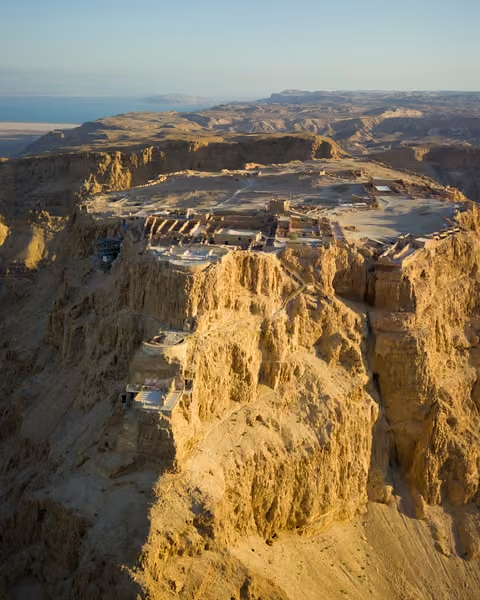
Masada
Ezekiel under the synagogue floor · Ezekiel 37:11-14.
Read aloud: Psalm 18:1-6, 1 Samuel 23:14-15, Ezekiel 37:11-14.
Psalm 18:1-6
I love you, Yahweh, my strength. Yahweh is my rock, my fortress, and my deliverer; my God, my rock, in whom I take refuge; my shield, and the horn of my salvation, my high tower. I call on Yahweh, who is worthy to be praised; and I am saved from my enemies. The cords of death surrounded me. The floods of ungodliness made me afraid. The cords of Sheol were around me. The snares of death came on me. In my distress I called on Yahweh, and cried to my God. He heard my voice out of his temple. My cry before him came into his ears.
Why here
A diamond-shaped rock rising sheer from the desert floor, ringed by cliffs, holding Herod's palaces and storerooms in the sky.
David hid in the metzadot, the strongholds of this wilderness, long before Herod built here, and the psalm he wrote gave the mountain its meaning in advance: You are my fortress, my metzuda.
In the year 73, after Jerusalem fell, the last rebels of the great revolt held this rock against a Roman legion, and when the ramp was finished, chose death as free people over slavery.
The mountain has been Israel's hardest question ever since.
Living people
The defenders.
Nine hundred sixty men, women and children, watching a ramp rise toward them day by day.
Whatever one concludes about their final choice, their love of freedom was written at the price of everything they had.
For decades, soldiers of the new Israel swore their oath on this summit: Masada shall not fall again.
David, earlier.
The difference between him and the defenders is the whole psalm: he hid in the strongholds but never called the rock his rock.
My fortress, he said, is a Person.
Stone Masada can fall.
His cannot.
One thing the eye can verify
Here is the detail that turns this mountain over.
Under the floor of Masada's synagogue, the excavators found buried scroll fragments, and among them the vision of Ezekiel 37: the valley of dry bones, the promise that the dead nation would live again.
The last free Jews of the revolt buried national resurrection under the floor of national death, and nineteen centuries later their descendants dug it up, in Hebrew, in a sovereign Israel.
Read Ezekiel 37 on the summit at sunrise and try to finish it with a steady voice.
One Hebrew word
מְצוּדָה Metzuda, fortress, stronghold. The mountain's name is a word from David's psalms, and the psalms keep making one correction: the metzuda that cannot be taken is not made of rock. It is the Rock.
One question
The defenders trusted a rock that could be ramped. David trusted a Rock that could not. Name your current fortress honestly: which kind is it?
A prayer
Lord, You are our metzuda, our high tower that no ramp reaches. We remember the ones who died free on this rock, and we read the dry bones prophecy they buried, standing in its fulfillment. Breathe on our slain, that they may live. And be Yourself our fortress, forever. Amen.
Nearby
- Dead Sea The lowest place on earth, with a healing on its calendar.
- Ein Gedi The spring of the wild goats, where David put down the knife.
- Mount Sodom The salt ridge, and the warning not to look back.
In Judea & desert. Before: Mount Sodom. Next: Jericho.
Same book: Jerusalem (Psalm), The Old City (Psalm).
Walk this place with me. A private day.