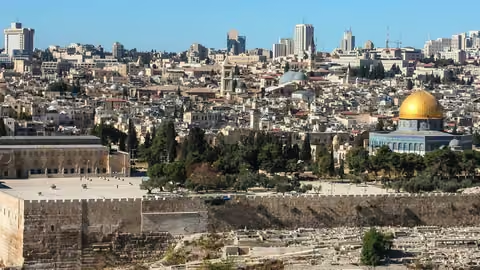
Jerusalem
One city, from David's spur to this morning.
Read aloud: Psalm 122, 2 Samuel 7:8-17.
Psalm 122
I was glad when they said to me, “Let’s go to Yahweh’s house!” Our feet are standing within your gates, Jerusalem; Jerusalem, that is built as a city that is compact together; where the tribes go up, even Yah’s tribes, according to an ordinance for Israel, to give thanks to Yahweh’s name. For there are set thrones for judgment, the thrones of David’s house. Pray for the peace of Jerusalem. Those who love you will prosper. Peace be within your walls, and prosperity within your palaces. For my brothers’ and companions’ sakes, I will now say, “Peace be within you.” For the sake of the house of Yahweh our God, I will seek your good.
Why here
Hold the whole story in one breath.
David takes the spur, around three thousand years ago. Solomon builds the house. Babylon burns it and drags the singers to the rivers of exile, where they swear: if I forget you, O Jerusalem.
They return and rebuild. Herod makes it magnificent. Rome makes it rubble. For nineteen centuries the city passes hand to hand, while the exiles keep praying toward it three times a day from every corner of the earth.
In 1948 the state returns and the city is cut in two. In 1967 the paratroopers reach the wall and weep. And this morning, children walked to school inside the gates your feet are standing in.
The psalm is not history. It is a live broadcast.
Living people
The pilgrims of every century.
The psalm was written for walkers: tribes going up, sandals on stone, the same three words in their mouths, our feet are standing.
Roman-era pilgrims, medieval pilgrims who walked for a year, you who flew for a day. One unbroken procession, three thousand years long, and today you are the ones inside the gates.
The rememberers. Every Jewish wedding for two thousand years has ended with a broken glass and this city's name. No city on earth has been remembered harder.
One thing the eye can verify
In the Jewish Quarter, children play beside a massive stretch of stone called the Broad Wall, built by King Hezekiah when Isaiah walked this city.
That one glance is the whole lesson of Jerusalem: the deepest past and the ordinary present, side by side, a toddler's ball bouncing against Isaiah's wall.
Every layer of this city is still in use. Nothing here ever fully becomes the past.
One Hebrew word
יְרוּשָׁלַיִם Yerushalayim, Jerusalem. The name ends in the Hebrew dual form, the ending reserved for things that come in pairs, like eyes and hands. The old teachers said: because there are two of her, the Jerusalem below and the Jerusalem above, and the city you are walking in is where they touch. Buried in her name is shalem: wholeness, peace. The city's name is a prayer the world is still learning to say.
One question
Three thousand years of pilgrims said the same sentence: our feet are standing within your gates. Now it is your feet. What did you carry up here, and what will you leave?
A prayer
Lord, we pray for the peace of Jerusalem, as Your word commands. Peace within her walls. Peace in her houses and her schools and her markets, for our brothers' and companions' sakes. Guard the city where heaven and earth touch, and count our feet among the generations that stood glad within her gates. Amen.
Nearby
- The Old City One square kilometer, four quarters, every century still open.
- Western Wall The Kotel, where the prayers of the whole earth land.
- Church of the Holy Sepulchre With the rich in his death · Isaiah 53:9.
In Within the walls. Before: Western Wall. Next: Southern Steps.
Same book: Golgotha (Psalm), The empty tomb (Psalm).
Walk this place with me. A private day.