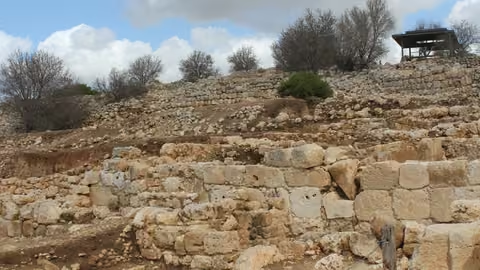
Shiloh
Where the Mishkan stood, and a woman invented whispered prayer.
Read aloud: 1 Samuel 1:9-20, 1 Samuel 3:19-21.
1 Samuel 1:9-20
So Hannah rose up after they had finished eating and drinking in Shiloh. Now Eli the priest was sitting on his seat by the doorpost of Yahweh’s temple. She was in bitterness of soul, and prayed to Yahweh, weeping bitterly. She vowed a vow, and said, “Yahweh of Armies, if you will indeed look at the affliction of your servant, and remember me, and not forget your servant, but will give to your servant a boy, then I will give him to Yahweh all the days of his life, and no razor shall come on his head.” As she continued praying before Yahweh, Eli saw her mouth. Now Hannah spoke in her heart. Only her lips moved, but her voice was not heard. Therefore Eli thought she was drunk. Eli said to her, “How long will you be drunk? Get rid of your wine!” Hannah answered, “No, my lord, I am a woman of a sorrowful spirit. I have not been drinking wine or strong drink, but I poured out my soul before Yahweh. Don’t consider your servant a wicked woman; for I have been speaking out of the abundance of my complaint and my provocation.” Then Eli answered, “Go in peace; and may the God of Israel grant your petition that you have asked of him.” She said, “Let your servant find favor in your sight.” So the woman went her way, and ate; and her facial expression wasn’t sad any more. They rose up in the morning early, and worshiped before Yahweh, and returned, and came to their house to Ramah. Then Elkanah knew Hannah his wife; and Yahweh remembered her. When the time had come, Hannah conceived, and bore a son; and she named him Samuel, saying, “Because I have asked him of Yahweh.”
Why here
Before Jerusalem, there was Shiloh.
The Mishkan, the Tabernacle of the wilderness, rested here for close to four centuries by the old reckoning, tucked in a quiet bowl of hills just off the Ridge Route.
Israel's festivals, sacrifices and pilgrimages all came here first.
Here the boy Samuel heard his name called in the night, and here childless Hannah prayed the prayer that became the pattern: lips moving, voice unheard, soul poured out.
When Jeremiah later wanted to warn Jerusalem that no holy place is automatic, he said: go to Shiloh, and see.
Living people
Hannah.
A woman in bitterness of soul who brought it directly to God and was mistaken for a drunk by the priest on duty.
Her silent prayer became, in Jewish tradition, the model of all prayer: the Amidah is whispered to this day because of her.
She asked for a son and gave him back, and the son was Samuel.
Eli.
The old priest who misjudged her in one verse and blessed her in the next.
Even tired religion can still hand out a true blessing.
One thing the eye can verify
On the tel, archaeologists traced a flat cut platform whose dimensions fit the courtyard of the Mishkan described in the Torah, and the site today marks its likely footprint.
Stand there and consider: for centuries this quiet hill was the address of the Presence, and today the wind crosses an empty floor.
Go to Shiloh and see, said Jeremiah.
You just did.
One Hebrew word
תְּפִלָּה Tefila, prayer. At Shiloh the word learned its posture from Hannah: not performance, not volume, a soul poured out with the voice turned off. Every whispered prayer in every synagogue on earth is quoting her.
One question
Hannah gave back the very thing she begged for. If God granted the request you are carrying right now, would you have the strength to dedicate it back to Him?
A prayer
Lord, You heard a whisper at Shiloh over all the noise of the festival. Hear ours. We pour out our souls like Hannah, for the children we long for, the answers that delay, the requests too heavy to say out loud. Look, remember, and do not forget Your servants. Amen.
Nearby
- Bethel The house of God, and the gate of heaven.
- Ai The ruin that taught Israel about hidden things.
- Mount Gerizim The valley of the blessing and the curse.
In Samaria. Before: Mount Gerizim. Next: Bethel.
Same book: Nabi Samuel (1 Samuel), Shepherd's Fields (1 Samuel).
Walk this place with me. A private day.