Library · Upper Galilee & Golan
Gamla
The camel-hump city of the Golan, where the vultures ride the wind.
Read aloud: Acts 5:33-39, Deuteronomy 4:41-43.
Acts 5:33-39
But they, when they heard this, were cut to the heart, and were determined to kill them. But one stood up in the council, a Pharisee named Gamaliel, a teacher of the law, honored by all the people, and commanded to put the apostles out for a little while. He said to them, “You men of Israel, be careful concerning these men, what you are about to do. For before these days Theudas rose up, making himself out to be somebody; to whom a number of men, about four hundred, joined themselves: who was slain; and all, as many as obeyed him, were dispersed, and came to nothing. After this man, Judas of Galilee rose up in the days of the enrollment, and drew away some people after him. He also perished, and all, as many as obeyed him, were scattered abroad. Now I tell you, withdraw from these men, and leave them alone. For if this counsel or this work is of men, it will be overthrown. But if it is of God, you will not be able to overthrow it, and you would be found even to be fighting against God!”
Why here
Gamla rides a ridge shaped like a camel's hump in the heart of the Golan, the Jewish capital of this region in the days of the Second Temple.
This is the home country of Judas of Galilee, the rebel Gamaliel names in his speech, the man whose revolt against the Roman census lit a fire that never fully went out.
Two generations later that fire consumed Gamla itself: the city fell to Rome in the year 67, thousands died on these slopes, and it was never rebuilt.
The Masada of the north, except this one is in the Bible's backyard, in your Golan.
Living people
Gamaliel.
The most respected teacher of his generation, Paul's own rabbi.
In a room boiling with rage he stands up and offers the calmest test in scripture: if it is from men it will fall, if it is from God you cannot stop it.
Judas of Galilee.
The proof of the first half of the test.
A man of this region, burning with zeal, who chose the sword.
His movement scattered, his home city fell, his name survives as a warning inside another man's wisdom.
One thing the eye can verify
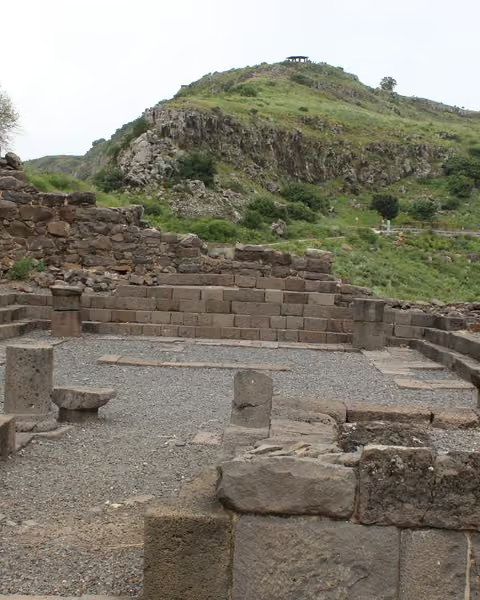
One of the oldest synagogues ever discovered stands at the entrance of the city, a synagogue where Golan Jews prayed while the Temple in Jerusalem still stood.
And above the cliffs, the griffon vultures circle on the wind, one of the largest colonies in the country.
Stones that outlived an empire below, wings that outlived everything above.
Gamaliel's test, written on a hillside.
One Hebrew word
גָּמָל Gamal, camel. The city is named for the shape of its own hill. In this land even the names are honest: the place simply tells you what it is, and then history tells you what it became.
One question
Gamaliel's test cuts both ways. Which of your battles is truly God's work that cannot be stopped, and which is only yours, defended by zeal alone?
A prayer
Lord, if a work is from men, let it fall away from us. And if it is from You, let nothing overthrow it. Search everything we are building, on our farms, in our families, on this wall of prayer. Keep us from fighting against You while calling it faith. We would rather stand with You in a small thing than against You in a great one. Amen.
Nearby
- Hazor The head of all those kingdoms, on the highway to Damascus.
- Tel Kedesh A city of refuge in Naphtali.
- Banias, Caesarea Philippi At the foot of Mount Hermon, where a river bursts from the rock.
In Upper Galilee & Golan. Before: Mount Hermon. Next: Hazor.
Same book: Akko (Acts), Caesarea Maritima (Acts).
Walk this place with me. A private day.