Library · Upper Galilee & Golan
Tel Kedesh
A city of refuge in Naphtali.
Read aloud: Joshua 20:1-9, Judges 4:6-10, Judges 4:4-10.
Joshua 20:1-9
Yahweh spoke to Joshua, saying, “Speak to the children of Israel, saying, ‘Assign the cities of refuge, of which I spoke to you by Moses, that the man slayer who kills any person accidentally or unintentionally may flee there. They shall be to you for a refuge from the avenger of blood. He shall flee to one of those cities, and shall stand at the entrance of the gate of the city, and declare his case in the ears of the elders of that city. They shall take him into the city with them, and give him a place, that he may live among them. If the avenger of blood pursues him, then they shall not deliver up the man slayer into his hand; because he struck his neighbor unintentionally, and didn’t hate him before. He shall dwell in that city until he stands before the congregation for judgment, until the death of the high priest that shall be in those days. Then the man slayer shall return, and come to his own city, and to his own house, to the city he fled from.’” They set apart Kedesh in Galilee in the hill country of Naphtali, Shechem in the hill country of Ephraim, and Kiriath Arba (also called Hebron) in the hill country of Judah. Beyond the Jordan at Jericho eastward, they assigned Bezer in the wilderness in the plain out of the tribe of Reuben, Ramoth in Gilead out of the tribe of Gad, and Golan in Bashan out of the tribe of Manasseh. These were the appointed cities for all the children of Israel, and for the alien who lives among them, that whoever kills any person unintentionally might flee there, and not die by the hand of the avenger of blood, until he stands trial before the congregation.
Why here
The north was given a door for the desperate. Joshua set cities of refuge so a person who killed without hatred could run and live until the congregation heard the case. Kedesh in Galilee, in the hill country of Naphtali, is one of those doors.
Why here of all places? Because refuge has to be reachable. The roads of the north had to have a place you could flee to before revenge finished the story. Later Deborah sent Barak from Kedesh-Naphtali toward Tabor. The same hills held both sanctuary and the call to war. Geography keeps both.
Living people
The manslayer, unnamed on purpose. The law is not interested in his fame. It is interested in whether his hands were accidental, and whether a city would open.
Deborah and Barak. She sends him from Kedesh with ten thousand. Refuge is not cowardice. Sometimes the same ground that hides the frightened also sends the army.
One thing the eye can verify
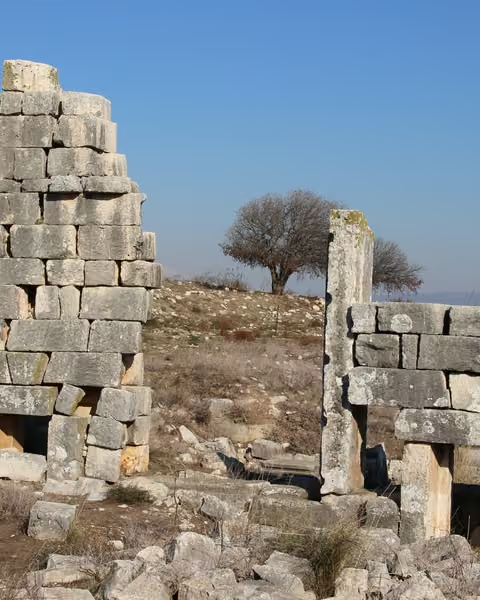
Walk the tel. You are in the far north, not far from the springs of Dan. A person running here was running toward the edge of the land. Your eye can feel the distance. Refuge is costly because it is far, and still God put it on the map.
One Hebrew word
מִקְלָט miklat, refuge. A miklat is not a hideout. It is a legal home until the truth is heard. Kedesh means holy, set apart. The holy town was the one that would take you in.
One question
Who in your life is still running, and have you been a Kedesh or a closed gate?
A prayer
Lord, You set cities of refuge in this land. Make our homes miklat. Hear the cases we have judged too fast. And from Kedesh send us, when it is time, with courage like Barak's, not with revenge. Amen.
Nearby
- Hazor The head of all those kingdoms, on the highway to Damascus.
- Abel Beth Maacah The northern town where a wise woman saved a city.
- Tel Dan The northern gate of the land · the springs where the Jordan is born.
In Upper Galilee & Golan. Before: Abel Beth Maacah.
Same book: Yardenit (Joshua), Mount Ebal (Joshua).
Walk this place with me. A private day.