Ashkelon
Philistine country, where the idol fell on its face.
Read aloud: 1 Samuel 5:1-5, Judges 14:19, 2 Samuel 1:17-20, Zephaniah 2:1-7.
1 Samuel 5:1-5
Now the Philistines had taken God’s ark, and they brought it from Ebenezer to Ashdod. The Philistines took God’s ark, and brought it into the house of Dagon, and set it by Dagon. When the people of Ashdod arose early on the next day, behold, Dagon had fallen on his face to the ground before Yahweh’s ark. They took Dagon, and set him in his place again. When they arose early on the following morning, behold, Dagon had fallen on his face to the ground before Yahweh’s ark; and the head of Dagon and both the palms of his hands were cut off on the threshold. Only Dagon’s torso was intact. Therefore neither the priests of Dagon, nor any who come into Dagon’s house, step on the threshold of Dagon in Ashdod, to this day.
Why here
Ashkelon and Ashdod were two of the five lords' cities of the Philistines, the Sea Peoples who landed on this coast about when Israel came up from the desert, and the southern Via Maris ran right through their gates.
Israel held the hills, the Philistines held the coast road, and the whole book of Judges and Samuel is the grinding of those two plates.
Here the captured ark spent its strangest exile: no army rescued it.
It simply stood in the enemy's temple, and the enemy's god kept falling on his face before it, until they begged it to leave.
1 Samuel 5:1-5 · also: Judges 14:19 · 2 Samuel 1:20
Living people
Dagon.
A character with no lines.
He falls, is propped up by his own priests, and falls again, this time losing his head and hands on his own threshold.
The idol's maintenance crew is the sermon: a god who must be set back in his place each morning is not a god.
The priests of Ashdod.
They saw the evidence twice and responded by changing their doorstep etiquette instead of their hearts.
Superstition is what remains when truth is refused.
Samson.
His fury reached Ashkelon too, one man against the lords of the coast.
One thing the eye can verify
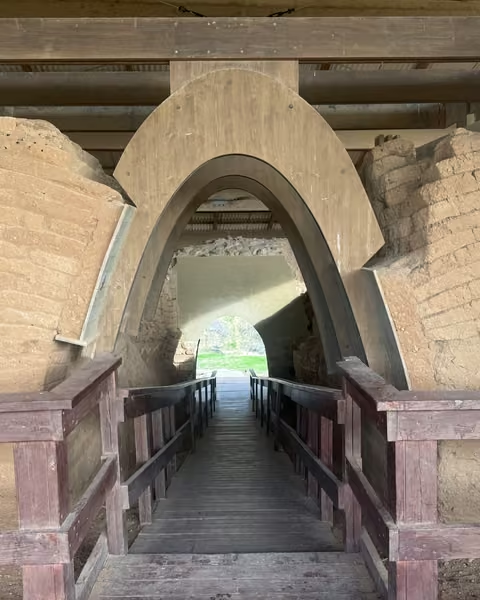
In Ashkelon's national park stands the oldest arched city gate on earth, mud brick, from the days of Abraham, and the ancient wells and ramparts of the Sea Peoples' city.
One small souvenir went out from here to every kitchen in the world: the little onion the Romans called the ascalonia, the scallion, named for Ashkelon.
Empires fall, and a green onion carries the city's name forever.
One Hebrew word
פְּלֶשֶׁת Peleshet, Philistia, this coastal strip. Centuries after the Philistines vanished, Rome renamed the whole land after them to erase Judea from the map, and the world learned the word Palestina. One Hebrew word explains two thousand years of headlines. The names of this land are never only names.
One question
Dagon's priests kept lifting their god back onto his stand. What in your life keeps falling on its face, and you keep setting it back in its place instead of letting it fall?
A prayer
Lord, no ark of Yours needs our rescuing, and no idol can stand the night in the same room with You. Walk into the temples we have built and let what must fall, fall. We will not prop it up again in the morning. You alone stay standing. Amen.
Nearby
- Simon the Tanner's roof The roof where the sheet came down.
- Jaffa The old port where one prophet fled and one apostle woke.
- Independence Hall A nation born in a day.
In Coast. Before: Jaffa. Next: Simon the Tanner's roof.
Same book: Gath (1 Samuel), Valley of Elah (1 Samuel).
Walk this place with me. A private day.