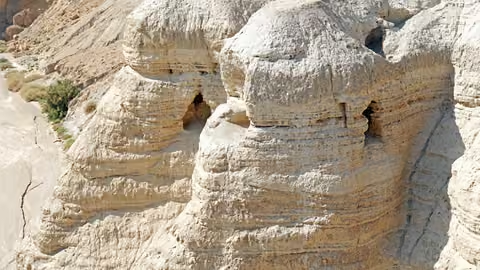
Qumran
The caves that kept the Word for two thousand years.
Read aloud: Isaiah 40:3-8, Isaiah 40:3-5.
Isaiah 40:3-8
The voice of one who calls out, “Prepare the way of Yahweh in the wilderness! Make a level highway in the desert for our God. Every valley shall be exalted, and every mountain and hill shall be made low. The uneven shall be made level, and the rough places a plain. Yahweh’s glory shall be revealed, and all flesh shall see it together; for the mouth of Yahweh has spoken it.” The voice of one saying, “Cry out!” One said, “What shall I cry?” “All flesh is like grass, and all its glory is like the flower of the field. The grass withers, the flower fades, because Yahweh’s breath blows on it. Surely the people are like grass. The grass withers, the flower fades; but the word of our God stands forever.”
Why here
A community of scribes withdrew to this shelf of desert above the Dead Sea to live out one verse: prepare the way of the Lord in the wilderness.
They copied scripture obsessively, and when Rome came in the year 68, they sealed their library in jars and hid it in the cliffs.
In 1947, in the same season the modern state was being born, a shepherd boy threw a stone into a cave and heard pottery break.
Out came the Dead Sea Scrolls: every book of the Hebrew Bible except Esther, a thousand years older than any copy previously known.
Living people
The scribes.
Men who ruled their lines, washed before writing the Name, and copied with a fidelity that still humbles science.
They thought they were preparing for the end of their world.
They were preserving the Word for ours.
The shepherd boy.
Muhammed edh-Dhib, chasing a stray goat, made the greatest manuscript discovery in history with one bored throw of a stone.
Heaven has always been comfortable using shepherds around here.
One thing the eye can verify
Stand at the lookout facing Cave 4, the honeycombed cliff that held tens of thousands of fragments.
Then hold the fact your group came for: the Great Isaiah Scroll, complete, all sixty-six chapters, dated a good two centuries before Jesus, reads essentially as your Isaiah reads.
And it contains the very verse: the grass withers, the flower fades, but the word of our God stands forever.
The scroll survived to prove the sentence written on it.
One Hebrew word
דָּבָר Davar, word. In Hebrew, davar means both word and thing, because a word from God is not a sound, it is a fact. The jars of Qumran held davar in both senses: words that turned out to be the most durable things in the desert.
One question
The scribes prepared for a future they never saw, and their faithfulness fed generations they never met. What are you copying carefully today for readers you will never know?
A prayer
Lord, the grass withered, the empires faded, and Your word stood forever in a clay jar. Make us keepers like the scribes and finders like the shepherd. Seal Your davar in us, and in the wilderness of our days, prepare Your way. Amen.
Nearby
- Qasr el Yahud The crossing and the baptism.
- Gilgal The first camp, and the stones that make children ask.
- Jericho The oldest city on earth, where walls fall and grace climbs trees.
In Judea & desert. Before: Hebron. Next: Ein Gedi.
Same book: Southern Steps (Isaiah), Pool of Siloam (Isaiah).
Walk this place with me. A private day.