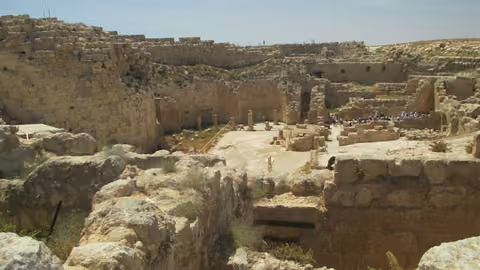
Herodium
The man-made mountain, in sight of the manger.
Read aloud: Matthew 2:1-18.
Matthew 2:1-18
Now when Jesus was born in Bethlehem of Judea in the days of King Herod, behold, wise men from the east came to Jerusalem, saying, “Where is he who is born King of the Jews? For we saw his star in the east, and have come to worship him.” When King Herod heard it, he was troubled, and all Jerusalem with him. Gathering together all the chief priests and scribes of the people, he asked them where the Christ would be born. They said to him, “In Bethlehem of Judea, for this is written through the prophet, ‘You Bethlehem, land of Judah, are in no way least among the princes of Judah: for out of you shall come a governor, who shall shepherd my people, Israel.’” Then Herod secretly called the wise men, and learned from them exactly what time the star appeared. He sent them to Bethlehem, and said, “Go and search diligently for the young child. When you have found him, bring me word, so that I also may come and worship him.” They, having heard the king, went their way; and behold, the star, which they saw in the east, went before them, until it came and stood over where the young child was. When they saw the star, they rejoiced with exceedingly great joy. They came into the house and saw the young child with Mary, his mother, and they fell down and worshiped him. Opening their treasures, they offered to him gifts: gold, frankincense, and myrrh. Being warned in a dream that they shouldn’t return to Herod, they went back to their own country another way. Now when they had departed, behold, an angel of the Lord appeared to Joseph in a dream, saying, “Arise and take the young child and his mother, and flee into Egypt, and stay there until I tell you, for Herod will seek the young child to destroy him.” He arose and took the young child and his mother by night, and departed into Egypt, and was there until the death of Herod; that it might be fulfilled which was spoken by the Lord through the prophet, saying, “Out of Egypt I called my son.” Then Herod, when he saw that he was mocked by the wise men, was exceedingly angry, and sent out, and killed all the male children who were in Bethlehem and in all the surrounding countryside, from two years old and under, according to the exact time which he had learned from the wise men. Then that which was spoken by Jeremiah the prophet was fulfilled, saying, “A voice was heard in Ramah, lamentation, weeping and great mourning, Rachel weeping for her children; she wouldn’t be comforted, because they are no more.”
Why here
Herod the Great sliced the top off one hill, piled it onto another, and built himself a cone-shaped mountain fortress you can see from Bethlehem, four kilometers away.
That fact is the whole page: the king who ordered the children of Bethlehem killed built his monument within sight of the village he feared, and chose to be buried facing it.
Two kings entered history a few kilometers and a few years apart.
One built a mountain to be remembered.
One was laid in a feeding trough.
Living people
Herod.
The greatest builder this land ever knew: Caesarea's harbor, the Temple platform, Masada's palaces, and this private mountain.
He murdered sons, wives, and the infants of Bethlehem to hold a throne he lost anyway, to death, within a year or two of the child's birth.
The wise men.
Foreigners who read the sky, asked the wrong palace, and then obeyed the star past it.
They gave their treasures to a toddler in a village and went home by another way.
History remembers them as wise.
It calls Herod great only in stone.
One thing the eye can verify
In 2007, after a thirty-five-year search, archaeologist Ehud Netzer found Herod's tomb on the slope of this mountain: a shattered sarcophagus of rose-colored stone, deliberately smashed in antiquity.
The king who moved a mountain to be remembered lies broken on its side, while the child he hunted is worshiped this morning in ten thousand languages.
Climb the cone, look at Bethlehem, and let the view finish the sermon.
One Hebrew word
עָפָר Afar, dust. For dust you are, and to dust you shall return. Herod moved a mountain of afar to escape the verse, and became its illustration. In this land even the greatest builders end up as archaeology.
One question
Herod built a mountain against being forgotten, and is remembered mainly for his fear. What are you building to be remembered by, and would the wise men call it wise?
A prayer
Lord, keep us from building mountains against our own smallness. Let us be like the travelers who followed Your light past the palace, worshiped low, and went home another way. And when we are dust, let what remains of us be worship, not walls. Amen.
Nearby
- Shepherd's Fields The night fields east of Bethlehem.
- Bethlehem The house of bread, where the Bread of Life was laid in a feeding trough.
- Hebron The city of the friend, and the first deed in the Bible.
In Judea & desert. Before: Shepherd's Fields. Next: Hebron.
Same book: Southern Steps (Matthew), Pater Noster (Matthew).
Walk this place with me. A private day.