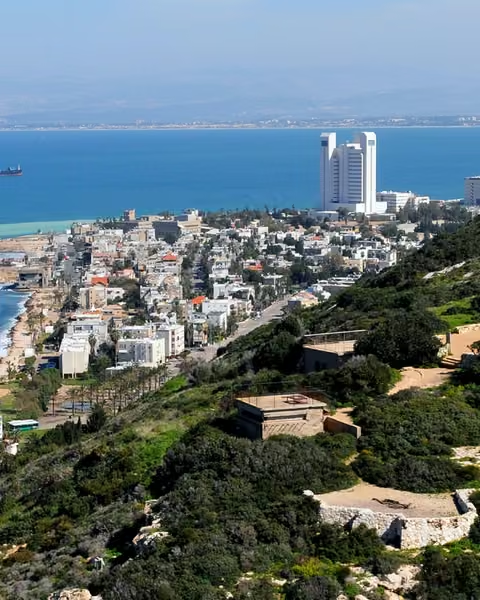
Mount Carmel, Muhraka
How long will you waver · 1 Kings 18:20-40.
Read aloud: 1 Kings 18:20-40, 1 Kings 18:41-45.
1 Kings 18:20-40
So Ahab sent to all the children of Israel, and gathered the prophets together to Mount Carmel. Elijah came near to all the people, and said, “How long will you waver between the two sides? If Yahweh is God, follow him; but if Baal, then follow him.” The people didn’t say a word. Then Elijah said to the people, “I, even I only, am left as a prophet of Yahweh; but Baal’s prophets are four hundred fifty men. Let them therefore give us two bulls; and let them choose one bull for themselves, and cut it in pieces, and lay it on the wood, and put no fire under; and I will dress the other bull, and lay it on the wood, and put no fire under it. You call on the name of your god, and I will call on Yahweh’s name. The God who answers by fire, let him be God.” All the people answered, “What you say is good.” Elijah said to the prophets of Baal, “Choose one bull for yourselves, and dress it first, for you are many; and call on the name of your god, but put no fire under it.” They took the bull which was given them, and they dressed it, and called on the name of Baal from morning even until noon, saying, “Baal, hear us!” But there was no voice, and nobody answered. They leaped about the altar which was made. At noon, Elijah mocked them, and said, “Cry aloud, for he is a god. Either he is deep in thought, or he has gone somewhere, or he is on a journey, or perhaps he sleeps and must be awakened.” They cried aloud, and cut themselves in their way with knives and lances until the blood gushed out on them. When midday was past, they prophesied until the time of the evening offering; but there was no voice, no answer, and nobody paid attention. Elijah said to all the people, “Come near to me!”; and all the people came near to him. He repaired Yahweh’s altar that had been thrown down. Elijah took twelve stones, according to the number of the tribes of the sons of Jacob, to whom Yahweh’s word came, saying, “Israel shall be your name.” With the stones he built an altar in Yahweh’s name. He made a trench around the altar large enough to contain two seahs of seed. He put the wood in order, and cut the bull in pieces and laid it on the wood. He said, “Fill four jars with water, and pour it on the burnt offering and on the wood.” He said, “Do it a second time;” and they did it the second time. He said, “Do it a third time;” and they did it the third time. The water ran around the altar; and he also filled the trench with water. At the time of the evening offering, Elijah the prophet came near and said, “Yahweh, the God of Abraham, of Isaac, and of Israel, let it be known today that you are God in Israel and that I am your servant, and that I have done all these things at your word. Hear me, Yahweh, hear me, that this people may know that you, Yahweh, are God, and that you have turned their heart back again.” Then Yahweh’s fire fell and consumed the burnt offering, the wood, the stones, and the dust; and it licked up the water that was in the trench. When all the people saw it, they fell on their faces. They said, “Yahweh, he is God! Yahweh, he is God!” Elijah said to them, “Seize the prophets of Baal! Don’t let one of them escape!” They seized them; and Elijah brought them down to the brook Kishon, and killed them there.
Why here
Carmel is the rain gate of the land, the first ridge the sea clouds strike, green when everything else is brown.
And Baal was sold to Israel as the rain god, the storm rider.
So the drought was already a duel before Elijah ever proposed one: three rainless years on the rain god's own mountain.
When Elijah called for the contest here, he was challenging Baal on Baal's home court, in front of the whole nation, at the end of a drought that had already proven who holds the sky.
The Arabic name of this spot remembers the verdict: Muhraka, the place of burning.
1 Kings 18:21, 36-39 (read the full contest in vv. 20-40)
Living people
Elijah.
One man against four hundred fifty, and against something worse than prophets: a nation that answered him not a word.
He rebuilt a broken altar with twelve stones, drowned it in water, and prayed a prayer you can read aloud in under thirty seconds.
The shortest prayer won the longest silence.
The people.
They wavered between two sides until the fire chose for them, and then they fell on their faces with one sentence: Yahweh, He is God.
In Hebrew, that sentence is a name: Eliyahu.
One thing the eye can verify
Stand at the statue of Elijah and look at the view: the Kishon brook below, the Jezreel spread eastward, Tabor and Moreh and Gilboa in a line.
Then hear the detail most visitors miss.
Elijah's own name, Eliyahu, means My God is Yahweh.
The answer to the contest was walking around inside the prophet's name the entire time.
The people's final cry simply repeated what his mother named him.
One Hebrew word
עֲנֵנִי Aneni, answer me. The heart of Elijah's prayer, hear me, answer me, and to this day the cry of Israel's prayers on fast days. One word, prayed by one man, and the sky tore open. Heaven is not moved by length.
One question
How long will you waver between the two sides? The people answered not a word. Where in your life are you still standing silent between two altars?
A prayer
Lord, answer us as You answered on Carmel. Not with fire we can boast of, but with the turning of hearts. End the drought in us. And when we waver between two opinions, choose us back, until we say with one voice: You are God. Amen.
Nearby
- Stella Maris The Carmel coast, where the servant looked for a cloud.
- Akko The harbor of the north, where Paul knelt on the beach.
- Caesarea Maritima Herod's harbor, where the door opened to the nations.
In Coast. Before: Independence Hall. Next: Caesarea Maritima.
Same book: Megiddo (1 Kings), Jezreel (1 Kings).
Walk this place with me. A private day.